

From Sinai to Today: Why Halacha Is Always a Living Conversation.
As Shavuot approaches, Jewish communities around the world prepare to do something extraordinary: not simply remember Mount Sinai, but in a sense, stand there again.

Shavuot is more than a commemoration of the giving of the Torah. Jewish tradition understands it as a re-enactment, a return to that moment of revelation, Covenant, and collective encounter. Each year, we place ourselves once more at Sinai, listening again for what Torah asks of us now.
In fact, Rav Soloveitchik claimed that the reading of the Torah in public (something done, for example, every Monday and Thursday morning) is not merely the collective recital of Torah text, but re-enacts the pivotal moment at Mount Sinai during which G-d’s word was delivered to a human audience.
And that raises a powerful question: What exactly was given at Sinai?
Was it only a fixed set of laws, frozen in time? Or was it the beginning of an unfolding conversation that continues across generations?
That is where our recent discussion with Rabbi Doron Chitiz, Rabbanit Gila Chitiz, and Ilana Stein becomes especially meaningful.
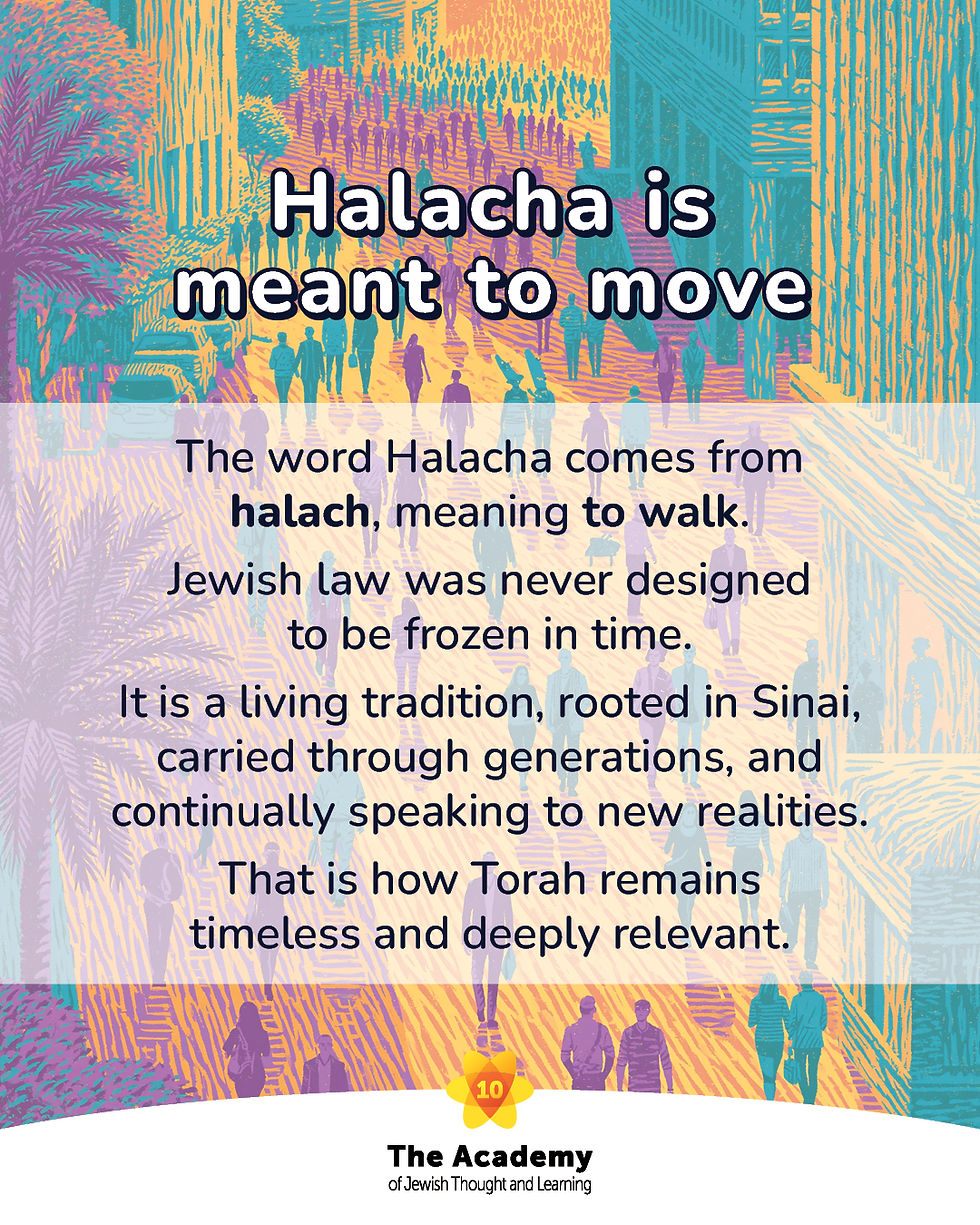
One of the most striking ideas raised in the conversation is embedded in the very word Halacha. As Rabbi Doron explains, Halacha comes from the root halach, meaning to walk, to move, to journey. Halacha was intended to be "Torah in motion". It is movement, rooted in revelation, carried through history, and continually applied to the realities of Jewish life.
From Sinai came Torah – both Written and Oral. From this amalgamation came Mishnah, Midrash and Gemara. From there came the medieval codifiers and literature, centuries of rabbinic debate, and today, entirely new halachic conversations around medicine, mental health, technology, women’s roles in Judaism, ethics in war, sovereignty in Israel, and questions no previous generation encountered practically.
And it is all part of the same chain. This is the miracle of Torah, not that it remains unchanged by history, but that it remains deeply itself while speaking meaningfully to new moments. Judaism encourages questions. The entire Talmud is built on them. Questioning is not a challenge to Torah, it is one of the ways Torah unfolds. Halacha lives in respectful debate, in nuance, in grappling honestly with complexity while remaining anchored in tradition.

That makes Shavuot feel newly alive.
Standing at Sinai is not only about receiving what was given then. It is about receiving Torah again now, in this generation, with this world’s questions, this era’s challenges, and this moment’s opportunities.
In many ways, we are living through an extraordinary chapter of halachic history. New books are being written. New areas of Jewish ethics are emerging. Women are taking up significant Torah scholarship, teaching and leadership roles.
Questions around modern medicine, psychology, artificial intelligence, and Jewish public life are opening fresh discussions that continue the conversation begun at Sinai itself.

This is Torah in motion.
This is Halacha being itself.
This is Sinai speaking.
This is why we invite learners into that unfolding story, from understanding the architecture of Halacha itself in The Anatomy of Halacha, to exploring women’s evolving participation in The Other Side of the Mechitzah.
The journey began at Sinai.
It did not end there.
It continues with us.
Step into the conversation with our podcast (links above) and then continue the conversation with us:
Facebook www.facebook.com/theacademysa
Instagram www.instagram.com/the_academy_sa
WhatsApp Community Group chat.whatsapp.com/HgqCPE9DDLs0PoP02LNGsy


Comments